Showing posts with label mountaintop removal. Show all posts

Monday, August 25, 2014

Mountaintop Removal: The High Cost of Coal

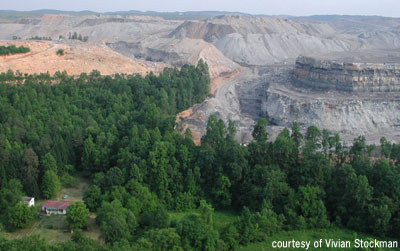
Left: Forest--Right: Mountaintop removal
Mountaintop removal means environmental destruction. We don't know the extent of this destruction because the Environmental Protection Agency (EPA) stopped studying its impact in 2001, when Deputy Director J. Steven Griles, a former coal industry lobbyist, cancelled the study. President Bush's friends had no interest in finding out about environmental damage in the Appalachians. Instead, Griles concentrated his efforts on finding ways to expedite mining permits without bothering to discover their effects on the environment.

Those effects are severe. The incomplete study released the following statistics before Bush pulled the plug:
  • More than 7 percent of Appalachian forests have been cut down and more than 1,200 miles of streams across the region have been buried or polluted between 1985 and 2001.
  • Over 1000 miles of streams have been permitted to be buried in valley fills.
  • Mountaintop removal mining, if it continues unabated, will cause a projected loss of more than 1.4 million acres by the end of the decade-an area the size of Delaware-with a concomitant severe impact on fish, wildlife, and bird species, not to mention a devastating effect on many neighboring communities.
  • 800+ square miles of mountains are estimated to be already destroyed.
Since the study was never completed, experts have estimated that it underestimates the problem by 40%. The damage described dates from the late 1990s. The coal industry depredations have continued without hindrance since then.

The area where this devastation is proceeding is one of the few wilderness areas in the northeastern United States. It is a region of beautiful forests teeming with wildlife: trees, creeks, birds, animals, fish. Few people hear about this rape of the land because coal companies buy all the land on the mountain and prevent anyone coming near enough to take pictures of what they do there. Their activities pollute the ground water in a watershed that provides drinking water for the residents of Pennsylvania, West Virginia, Virginia, Kentucky, and Tennessee.

The affects of air pollution caused by the coal mined in this region extend even farther. Georgia and North Carolina are the biggest users of Appalachian coal. Recently a leak at a Duke Coal Energy ash containment pond in North Carolina released 50 to 80 thousand tons of coal ash and 27 million gallons of contaminated water into the Dan River.

Thursday, May 22, 2014

Marita Noon provides disinformation on energy

An article recently appeared on the internet called, How energy from mountain top removal, fracking, and tar sands makes America great. This sentiment may surprise you. After all, we learned in school that what makes America great is liberty, democracy, equality, and other similar ideals.

The author of this article is Marita Noon. On Heartland.org, Noon is listed as an expert. The source of her expertise is completely unknown. She is not a scientist, an educator, or an engineer. She has no scientific degree that I have discovered. Around 20o8, Noon started writing articles and books and giving speeches on energy and energy policy. Before that, she wrote books on Christianity.

Heartland is well-known for its disinformation campaigns to protect corporations against law suits for all sorts of dangerous products. For example, about tobacco Heartland says 
The public health community's campaign to demonize smokers and all forms of tobacco is based on junk science. 
About asbestos, once again blaming junk science for public misconceptions, Heartland says 
Research has confirmed that asbestos workers who do not use protective breathing apparatus suffer increased health risks. For the remaining 99+ percent of the U.S. population, however, asbestos health risks are virtually nil.
This paragraph is in lawyer-speak. Translated into words we all can understand, it means that anyone exposed to airborne asbestos, including the spouses and children of those directly exposed, has an increased chance of getting mesothelioma, a rare, incurable, and painful form of cancer. This risk applies to anyone exposed to asbestos dust, including the first responders on 9/11.

Heartland is funded by the tobacco industry and the asbestos industry. It is also funded by the energy industry, since it received more than $600,000 from Exxon/Mobil and more than $200,000 from the Charles Koch Foundation. Exactly how much money the energy industry pays Heartland to spread disinformation can't be known because they're not telling. But it's plenty.

So I think we can fairly conclude that Noon is a flack for the energy industry.

Noon's article is filled with half-truths and outright lies. Commenting on Noon's article in the Daily Times, Bo Webb writes
Marita, you are not anywhere close on the truth of Mountaintop Removal.
Unlike Noon, Webb is an expert on Mountaintop Removal.

Among other misconceptions, Noon writes that
There were no federal programs with subsidies, tax breaks, and mandated markets to favor the shale industry.
This is false. Aside from the billions of dollars of federal subsidies going directly to the oil companies, the federal government spent $140 million to develop fracking technology starting in 1987.


Flacks like Noon and front groups like Heartland claim to be educating the people about important issues like energy policy and global warming. The truth is that they do precisely the opposite. They propagate lies and half-truths. They muddy the waters and make it difficult for the average person to understand an issue. We must expose these liars whenever possible and make it difficult for them to submit an article to a newspaper anywhere in the world.

Tuesday, February 25, 2014

Mountaintop Mining, Rebellious Lawyering, and a Hockey Stick

Version:1.0 StartHTML:0000000167 EndHTML:0000006122 StartFragment:0000000487 EndFragment:0000006106
Mountaintop removal is a particularly destructive form of coal mining. Coal mining companies employ it in the Appalachians because the coal seams there are narrow and would not repay the cost of deep mining. Think of a mountain as a series of thin layers. First, of course, is soil and its attendant features: Trees, plants, wildlife, streams—everything that we see when we visit a mountain.

All these things hold no interest for the coal mining company. They are just in the way. The layers underneath the surface are those where coal is found. In mountaintop mining, the mine operators strip off the top layers until they reach the layer of coal, the seam. The operators then strip off the coal, put it in trucks or trains, and ship it to market.

The operators are not done, though. There is more coal down below, so they repeat the process, again and again, until the mountaintop is gone. Also gone are topsoil, trees, streams, and underground water deposits—aquifers--where a home owner might drill a well for drinking water or irrigation. In short, the operators remove everything that is capable of supporting life; they leave only rocks.

People complained about this, of course. Not the local residents, who are all in one way or another dependent on the mine operators. But other people, environmentalists, naturalists, and those interested in the future use of the earth, what is now called sustainability. These people got the federal government to pass laws intended to protect the land. They required that the mine operators replace the rocks where they had been. They also passed the Clean Water Act, which required the streams flowing down from the mountain be clean enough to support aquatic life.

The mine operators have consistently ignored these laws. It is actually impossible to replace the rocks where the were originally. The volume of rocks increase once they are exposed to the air. So the mine operators decided it would be okay to dump the rocks in the stream beds. Neighbors might object, but the mine operators have bought nearly all the property in the mining region, so there are no more neighbors.

Likewise, there is no one who can sue under the Clean Water Act. The former residents are gone. The water is probably grossly polluted, but mine operators will not permit anyone to test it. They test it themselves and file their results with the Environmental Protection Agency (EPA). For years, the EPA has been collecting these reports and filing them without looking at them.

I learned all these facts at the Yale University Rebelaw conference from lawyers who had been suing mine operators for years. These lawyers seemed pessimistic about the future of the mining region. The Appalachians themselves are beautiful. Tourism could provide residents with sustainable income. But wherever coal was mined, the land became useless. The air was dusty, the water was poisonous, aquatic life could not exist where there were once mountain streams. The mine operators could not be stopped because they owned the state governments of West Virginia and Kentucky.

This certainly seemed like a no win scenario to me. I went back to my hotel room depressed about coal, which not only destroys the landscape while it is mined, but also contributes to global warming and air pollution while it is burned.

But my mood turned around after I turned on the tv and saw one of the most extraordinary plays I have ever seen in sports. In the Gold Medal hockey game between Sweden and Canada, Canada led by one goal. Not a very secure lead. The Swedes had a gifted goalie who was turning away shot after shot. Then one of the Canadian players—Sidney Crosby--stole the puck at the Canadian end of the rink. He took off running with no one between him and the goalie. When he arrived at the goal mouth, he passed the puck to his own backhand and dropped it into the goal past the helpless Swedish goalie.

It was a simple play. The puck was traveling at high speed past the goal and then, miraculously, turned and flew into the goal.

I was reminded of this play the next day, when, as I returned home on the train, I read that a federal judge had declared the mining operators in West Virginia were violating the protected species act. Just as the puck had turned abruptly in the hockey game, the future of the Appalachian mountains, with their rills, hollows, and history, had just changed. Now there is a chance to stop the mine operators from flaunting the law and destroying the land.


We should never lose hope in our struggle to save the planet from exploiters and their shills. Everything can change in an instant. And yes, Canada went on to win the Gold Medal in Hockey.