Four days ago, I attended an oil spill “vigil” at Manasota Beach. It was organized by MoveOn.Org, and “hosted” by a local woman, Julia. I agreed to attend, and to speak, and to bring posters, and I did all of the above.
I also invited twenty or so people whom I knew locally. None of them came.
No, actually, one of them came. My Uncle Don, he of the beachfront home, he of the East Coast conservative “upper crust” pretensions and heavy gold nautical jewelry... HE came.
I didn't even know he was there till the end, when he approached me, and we embraced and exchanged a few inconsequential civilities. I didn't ask him why he was there, and he didn't tell me... but I suspect it may have had something to do with his home, which fronts on the Gulf.
Later, out of curiosity, Allan looked up Don's blog, “The Storch Report”... and sure enough, Don had made a new posting. Apparently he had attended, more or less, with the idea of scouting out enemy territory. Certainly he had nothing useful, or kind, to say; his pronouncement on the event seemed to be that it accomplished nothing, and that the people there were all stupider than he was.
But then, that pretty much encapsulates his whole reason for writing, anyway.
At first, in thinking back, I had to agree with him that nothing had actually been accomplished... people came, people spoke, disparate opinions were expressed, but no single useful idea or plan of action came from the evening, that I could see. On consideration, however, I've decided that actually, something WAS accomplished... something important.
There was a lot of “venting”, and a lot of sharing of stories and information relating to the spill-- what I read fell into those categories. There were also a lot of opinions aired. One woman in an eccentric outfit got up and told us we needed to throw out all the incumbents; a man was there promoting his scheme to make and sell compressed-air cars. Another man, who said he had worked on oil rigs, insisted that BP had caused the spill on purpose. Equally ludicrous (and unfortunate, in that it spread false information) was the Vietnam vet who told us that the dispersant that is being used in the Gulf is actually closely related to Agent Orange (only 10 times as toxic) and that a whole lot of us were going to die, over the next 10 or 20 years.
(...actually, considering the median age of the crowd, that last statement was somewhat... no, I'm not even going to go there.)
A man came from the newspaper and went around interviewing people. There was also a woman whom I strongly suspect of being a Republican plant, as she told us all how Buchanan is really a great guy (she knows him personally) and it's those OTHER guys (like Nelson, the Democrat) that we need to keep on top of. Then she invited us all to come to an event she said she was organizing. EVIL.
A couple men mocked us, saying we were “preaching to the choir”, and that “you won't get anywhere putting up pictures of dead seabirds... nobody cares”. I noticed, though, that neither of them had any alternate suggestions, so far as I could tell.
In fact, it has been said that one picture of a dead sea-animal is more effective than 10,000 “tweets” from BP. I will continue to hope so.
The event was well-attended, for a rainy evening in Englewood in summer; there were between 40 and 70 people present. That in itself was a positive thing... because I know many (including myself) were surprised to find that they were less alone than they had thought. Still, the disparate nature of the many views expressed, and the lack of a practicable outcome were more than a little disheartening. Some people began to wander off, eventually, looking discouraged; others raised their voices in loud discussions, and all efforts at maintaining a coherent “meeting” were abandoned soon after that.
Since the meeting, I have been troubled in mind, with feelings more than a little mixed. On the one hand, I'm quite pleased with my own part in the vigil; my three posters were a big hit, and the article and speech I prepared met with a very satisfactory reception. Although I became emotional at a couple points while I read, I was able to regain control; beyond that, I felt that I spoke with an uncommon force and clarity. A number of people came up to me afterward to embrace me, press my hand, tell me how much what I had said had meant to them, and how I ought to send it into the newspaper.
All very heartening. Still, I wished that I had been able to do more than move people... but I was just like them. I had no idea what we could actually do.
One man waxed eloquent about how we could all conserve, individually, by riding mopeds and taking solar showers in the back yard, and so on... commendable, surely, but it doesn't clean up the spill, or stop companies like BP from continuing to maximize profits at the expense of everyone and everything else in the world.
IS there anything we can do, that would make any real difference?
I'm not sure. I've never been a “political” animal; I don't easily comprehend and retain the workings of the various institutions that drive us. Also I know myself to have definite limits when it comes to how much I can do, and what I can handle. Yet I'd very much like to help, somehow... because I do care, deeply.
I've had a few thoughts, over these past days-- nothing new, certainly, but just possibly worth remembering...
Firstly, I personally can contribute my strengths and gifts, if I can find a way to apply them. I can write well, speak well, sing well. I can inspire people, and move them. I also tend to think “outside the box” (possibly because I LIVE outside it). ALL potentially valuable.
Most of my thoughts, though, have been about people in general. How to “reach” them? How to begin to change their minds? How to get them to actually DO things? Those are the hardest questions.
In general, I think we need to EDUCATE people... by showing them the truth of things, and backing it up with proof, so that they will be protected from those spreading falsehoods. Then we need to organize those educated people to function as a larger force, such that they can begin to influence world events. That's what MoveOn.org has tried to do, and to a certain extent, they have succeeded... they were a big factor in Obama's victory, after all.
They've done something else worth noting: they inspired Julia, and with her help, they brought together 40-70 environmentally-concerned people in the small and conservative town of Englewood, and got them to talk to each other. They got the newspapers and TV to pay attention, too, and they got people to notice that their neighbors were really riled about this Gulf thing... and that they were trying to do something. I'm not sure that's ever happened before... but I have a feeling it WILL happen again.
One of the things I keep thinking about is the concept of “critical mass”. When a critical mass is reached, say, in a physical or chemical reaction, things start to happen. I've often heard, in past years, that consciousness has a critical mass, too: that when enough people come to care about something, then, suddenly, they can create change... whether it's change in beliefs, in laws, or in the way the world is run.
Another thing worth remembering, I think, is that people are much more motivated to do things when they figure them out on their own, than when they are told, or ordered, to do them. Every good teacher knows this... that when kids “learn by doing”, they absorb much more than when they are lectured at, or ordered around.
The third idea that has been much in my mind, goes hand-in-hand with the previous one, and is a very old one, beloved of advertisers everywhere: “sex” sells.
I don't actually mean SEX, of course... a more accurate word might be “seduction”. Make an idea seductive, make it exciting, make it fun and appealing and interesting, and that idea will sell faster than you can say “iPad”.
Can sustainability be sexy? Yes, I think that's doable... and we need to find ways to do it, if we are to save this world. Unfortunately, it will take more than sexiness to save the Gulf. What CAN we do, in that regard?
I suspect that if there were a large enough public outcry, that Obama would feel it incumbent upon him to take actions that the large, ugly powers around him might disapprove of... like taking control of BP, perhaps, or seizing their assets. I am informed that he actually does have the power to do both of those things, in an emergency situation, without having to get it through Congress, et al. I don't KNOW that the government would do a better job than BP, but I suspect they would, because they wouldn't be averse to bringing in any experts that might be able to help... whereas BP wants to keep things secret, and to only use its own people. Plus, while I'm sure BP does want to stop the leak, I don't believe they want that as much as they want to continue to make a profit. Their capitalist motives are hurting the world.
In point of fact, capitalist motives have been doing an awful lot of harm recently. More and more, I wonder whether capitalism itself is to blame... or whether the problem has more to do with Big Business, and Big Banking. I DO know I will never again vote for anyone who has been CEO of a big corporation... because you only get into that position by putting profit FIRST.
Maybe that's why I'm not rich... because I believe putting profit first, is WRONG. Put people first, put Earth's welfare first... but I think Hippocrates said it best: “First, do no harm”. Doctors swear the Hippocratic Oath, yet because we are a capitalist society, most of them end up putting profit first, patients second.
Am I becoming...(gasp)... a Socialist?
Friday, June 18, 2010


Friday, April 30, 2010
Arizona has passed a very bad law
The state of Arizona has recently passed a new law that persecutes latino-American citizens in the name of controlling immigration from Mexico.
Arguing about this law with conservatives makes my head explode.
This law is simply bad law. Only the Supreme Court can determine whether it is unconstitutional, yet one conservative after another declares it is constitutional. Evidently being a talking head on Fox gives you insight into the future decisions of SCOTUS.
But we can all see it is bad law, because it moves us closer to a police state, in which all private actions are closely watched by the police and no one is ever safe from police interference.
The law does not define what is "reasonable suspicion". It is vague and general, and relies on the discretion of the individual, unsupervised police officer. Whether there is proof the law will be abused is beside the point. The fact is, it could be abused, because it offers no guidelines for the police.
Some have assumed that the legislature would not have passed the law if they believed it to be unconstitutional. This is obviously not true. Laws are passed because the politicians believe their constituents want them passed. So this is a politically motivated law.
What is that motivation?
Many people of Arizona do not like latino immigrants. Furthermore, they have no objection to subjecting citizens of latino heritage to harassment by the police. So the legislature and governor scored political points by giving them a new law. Yielding to bigots and racists is not a good reason to create a new law.
Many people of Arizona are upset that the federal government has not resolved the issue of immigration. So the legislature passed the law to send a message to the federal government that immigration reform is necessary. By doing so, many of them must have realized that the states cannot legislate in areas where federal law takes precedence. Passing a bad law to punish the federal government makes no sense.
Many politicians of Arizona would like to make a popular gesture in an election year. This includes many Senators and Representatives, the very people that are responsible for making improvements to immigration laws. But these people are ducking their responsibility. Instead of taking responsibility for bad laws and making better ones, they blame the poor and powerless, the ones who are the targets of this very bad law.
This is a very bad law
1. Because it is at least partially motivated by racial hatred.
2. Because it is at least partially motivated by political animosity.
3. Because it permits the harassment and imprisonment of American citizens for the crime of being brown.
Arguing about this law with conservatives makes my head explode.
This law is simply bad law. Only the Supreme Court can determine whether it is unconstitutional, yet one conservative after another declares it is constitutional. Evidently being a talking head on Fox gives you insight into the future decisions of SCOTUS.
But we can all see it is bad law, because it moves us closer to a police state, in which all private actions are closely watched by the police and no one is ever safe from police interference.
The law does not define what is "reasonable suspicion". It is vague and general, and relies on the discretion of the individual, unsupervised police officer. Whether there is proof the law will be abused is beside the point. The fact is, it could be abused, because it offers no guidelines for the police.
Some have assumed that the legislature would not have passed the law if they believed it to be unconstitutional. This is obviously not true. Laws are passed because the politicians believe their constituents want them passed. So this is a politically motivated law.
What is that motivation?
Many people of Arizona do not like latino immigrants. Furthermore, they have no objection to subjecting citizens of latino heritage to harassment by the police. So the legislature and governor scored political points by giving them a new law. Yielding to bigots and racists is not a good reason to create a new law.
Many people of Arizona are upset that the federal government has not resolved the issue of immigration. So the legislature passed the law to send a message to the federal government that immigration reform is necessary. By doing so, many of them must have realized that the states cannot legislate in areas where federal law takes precedence. Passing a bad law to punish the federal government makes no sense.
Many politicians of Arizona would like to make a popular gesture in an election year. This includes many Senators and Representatives, the very people that are responsible for making improvements to immigration laws. But these people are ducking their responsibility. Instead of taking responsibility for bad laws and making better ones, they blame the poor and powerless, the ones who are the targets of this very bad law.
This is a very bad law
1. Because it is at least partially motivated by racial hatred.
2. Because it is at least partially motivated by political animosity.
3. Because it permits the harassment and imprisonment of American citizens for the crime of being brown.
Tuesday, August 18, 2009
Supreme Court: Scalia v Sanity
 In his article, Why Justice Scalia Wants to Execute the Innocent, Conor Clarke makes the astonishing statement that
liberals who are dumping on Justice Scalia for his dissent in the Troy Davis case...are being a bit harsh.Scalia and his right-wing cronies have been trying for years to limit the powers of the Supreme Court. But this time Scalia is saying that the high court has not got the power to correct a lower court ruling, even if the defendant in the case is innocent.
If the judges on the high court cannot protect the lives of innocent persons wrongfully convicted, what are they there for? In Justice Scalia's opinion, they are there to see that the correct procedures were followed.
Justice Scalia, in a dissent joined by Justice Clarence Thomas, said the hearing would be “a fool’s errand,” because Mr. Davis’s factual claims were “a sure loser.”Davis's appeal included a brief signed by 27 prosecuting attorneys and judges. These people are all convinced that Davis deserves another review of the evidence, based on changes in witness testimony and the possible impeachment of a major prosecution witness. But that's not good enough for Justice Scalia, because
This court has never held that the Constitution forbids the execution of a convicted defendant who had a full and fair trial but is later able to convince a habeas court that he is ‘actually’ innocent.It is obvious from this statement that the guilt or innocence of the defendant is immaterial. The only important thing is the "full and fair trial", in other words, that the process was correct. This is akin to the old bromide about the operation being a success, even though the patient died.
In Justice Scalia's view, the show trials of the Stalinist era were perfectly fine. The defendants were all tortured until they confessed and then sentenced to death by impartial judges. If nothing in the constitution prohibits the state from taking an innocent life so long as the rules of court procedure are followed, the powers of the state indeed become limitless. This is precisely the state of affairs that the framers of the Constitution wished to avoid, since there have always been legal systems where the conviction of someone for a crime is more important than whether he actually committed the crime.
Mr. Scalia's views support the contention that the state is more important than the individual, and that the purpose of the Constitution is to assure that the executive power can exercise its authority without interference from the judiciary. For if the state is permitted to execute people who are known to be innocent, and if the Supreme Court can refuse a new hearing because, in their opinion, the case of the defendant is "a sure loser", there is no judicial protection for anyone. Moreover, the state loses its prestige in the eyes of its citizens because they recognize that it tolerates injustice.
Process does not create justice. Wisdom and mercy together create justice. The deliberations of enlightened men create justice. The petty quibbles of Mr. Scalia can only debase and demolish it.
Tuesday, June 2, 2009
The Nation v. Dirty Harry
 Although masquerading as a movie review, Akiva Gottlieb's article in the Nation is nothing more than a diatribe against Clint Eastwood, filled with a priori judgments and inexplicable conclusions. What are we to make of his initial statement that people "have been writing Clint Eastwood's obituary about as long as the man's been making movies"? Which people? What obituaries? Gottlieb must make this completely unsupported statement to justify his conclusion that Eastwood himself encourages these nonexistent obituaries.
Eastwood was born in 1930, making him 37 during the Summer of Love (1967), and a bit long in the tooth to partake in its pleasures. He was certainly influenced by the beats, however, learning to play jazz piano and making a movie about jazz great Charlie Parker. Later he wrote musical scores for his own movies and is currently involved in a project about Dave Brubeck, another Jazz great.
The charge that Eastwood like a male "Athena emerged fully formed from the Nixon-era hive mind" is particularly absurd, unless you ignore his early work. As Rowdy Yates on TV's "Rawhide" Eastwood played a handsome young cowboy with a penchant for getting into trouble. The "Man With No Name" was an iconic western hero based on Toshiro Mifune's samurai warrior in Akira Kurasaki's "Yojimbo". Kurasawa pioneered the idea of having his actors wear "real" clothing; Eastwood bought his outfit in "Fistful of Dollars" in California and took it to Spain with him.
His grubby look in the movie and its two sequels owed more to Kurasawa and Sergio Leone than to Eastwood himself. In private life, he was a ladies' man, with numerous liaisons. His character in "The Beguiled", while still a soldier, was a pacifist who deserted during the Civil War. He was also an attractive young man. Perhaps a little too attractive.
Of course, Gottlieb may be referring only to the Dirty Harry persona that has clung to Eastwood throughout his career, although even then his reference to the Nixon era is inaccurate. The Man with No Name is almost indistinguishable from Dirty Harry. Both are accomplished warriors, both have no respect for authority, and both see themselves as fighting for good. While Gottlieb sees Harry/NoName as a manichaean figure, this is never the case in the movies. Harry is always deeply conflicted, trying to protect ordinary citizens but guilty about people he harms while he pursues his goal.
Since Gottlieb has nothing original to add, he cites Pauline Kael's review of Dirty Harry, published just 38 years ago. Kael accuses the movie of being fascist, but clearly knew nothing about what fascism is. Dirty Harry is the antithesis of fascism, which is characterized by intrusive state control in every aspect of people's lives. Even though he works for the state, Harry is continually at odds with his bosses. He takes his oath to protect and serve literally, but the people he works for are the common people. The enemy he challenges is anyone who abuses power. In The Dead Pool, the enemy is other cops, who have taken the law into their own hands. In the Gauntlet, it is an array of crooks and corrupt politicians. In the Unforgiven, it is the town sheriff and the town businessmen. In each of these cases, Clint is cast as the defender of little people against government run amok.
Thrashing around for someone to smear Eastwood with, Gottlieb runs into Ayn Rand, but once again has insufficient understanding of her subject to make the smear stick. Rand extolled the virtue of the individual, all right, but from the entirely fascist, Nietschean side. For Rand, superior individuals, whom Nietsche dubbed the "Supermen", are laws unto themselves. While this sounds similar to Dirty Harry, the resemblance is superficial. None of Clint's heroes is extraordinary except in their skill with weapons and their dogged determination. They all have working class roots. Cops, bounty hunters, a trucker, a wild-west show promoter, a country singer, a photographer, a secret service detective: None of these bears any resemblance to Rand's heroes: industrialists, a senator, and an architect. Harry is marked, not by his creativity and intelligence, but by his faithfulness to the ideal of justice and his persistence in its pursuit.
Gottlieb cites Harry's most famous line, "Go ahead, make my day", as a suggestion that killing can be fun. This removes the quote both from its context and from its delivery. Eastwood's character does not enjoy killing; the line is delivered with utter sarcasm and world-weariness. Harry does not seek violence; it is continuously thrust upon him. In Tightrope, his policeman persona relieves the stress of his job with sado-masochistic sex; in the Unforgiven, his persona escapes from a violent existence, only to be drawn back into it by poverty and the bonds of friendship.
Nearly all the conclusions of Gottlieb's article are false, clearly snap judgments based on a superficial knowledge of his subject. Others are incomprehensible. He does Eastwood an injustice with his sloppy scholarship and glib aspersions. Reviewing films may not be the most intellectual occupation, but it should at least strive for respectability.
Friday, May 29, 2009
Cyber Wars
 On 24 July 2008, Spam King Eddie Davidson [pictured at right] killed himself, his girl friend, and a child after walking away from a federal prison where he was serving a 21-month sentence for charges related to spamming activities.
Today, President Obama announced the creation of a new post, which he called Cyber Czar. This new position would have responsibilty for protecting world computer networks from attacks that cost the economy billions of dollars every years. The only surprising thing about his announcement is how long it took the government to take action.
Imagine if there were gangs of criminals roving the interstate highways, putting up phony signs that divert traffic from its intended course, stopping trucks and carrying off their cargo, and causing delays and traffic jams on a daily basis. Wouldn't the public be enraged? Wouldn't government be forced to step in?
That's exactly what is happening to our "information superhighway." But even though most Americans use computers or rely on their performance in their daily lives, few understand how they work or what dangers lurk there.
The internet began as ARPAnet, a U. S. Deparment of Defense project back in the 1960s. Although security must have been a prime concern at that time, by the 1980s something had gone terribly wrong. Hacking, or breaking into a computer network surreptitiously, was considered by many to be an innocent pastime. The movie "War Games(1983)" showed how a teenager might hack into a top secret military computer. Although the story was somewhat fanciful, still there were many computer users who amused themselves by trying to gain access to various computer networks.
As the Internet exploded, both the opportunities for hacking and the danger from abuse escalated dramatically. Today, there are thousands of hackers, some of them amateurs, but many others professionals employed by governments, who are busily at work trying to defeat the plans that have been laid to protect our data, our websites, and ultimately, our lives. Since computers intrude into every aspect of our lives, they control information that could be used to fire weapons, or prescribe medications, to direct traffic on busy highways, or suck funds out of bank accounts.
Internet Enemy Number One: Spam.
Much of the president's attention is focused on "cyber attacks", where networks are invaded, usually to obtain information, but sometimes to disrupt operations. The most expensive kind of attack, however, is the most common, one which every computer use encounters every day. It's called spam. The propagation of spam, unsolicited email messages, is as sophisticated as any network breakin. In fact, they use the same tools and have developed similar tactics to evade detection.
What does the sending of spam involve? In the first place, the spammer must have some method of gathering millions of email addresses. This may be accomplished by software programs called "spiders" that enter every website on the internet and harvest email addresses, which are later used for spam or sold to spammers. These programs are sold openly on the internet. Greedy and unscrupulous people have sold books and articles about email "marketing" in which they explain how to send spam and make money doing it.
Advanced spamming also uses viruses, trojan horses, and malware. Trojan horses take over your computer and use it to send spam. Malware installs itself on your computer and steals all your email addresses. When a hacker manager to install malware on large computers like government or university databases, it can steal thousands or even millions of email addresses at the same time. This same ability to steal email addresses and take over computers can also be used to steal data, like bank records, social security records, and medical records.
Cyber Wars
During the Cold War, computer programmers employed by governments on both sides of the iron curtain invented programs to disrupt or disable computer networks of the other side. Bulgaria was particularly active in this area, which was related to "cracking", a way of making commercial software available to users who had not purchased a legal copy. So a programmer could make a "cracked" copy of Microsoft Word, for example, and hundreds of people could use the pirated copy without paying royalties to Microsoft. Other programs were also placed on these disks, viruses and trojan horses, which could use the installer as an entry point into a computer.
Since the end of the cold war, programmers trained by their governments in hacking techniques have gone rogue, so to speak, continuing to practice their trade, either for monetary gain or for recognizable sociopathic reasons, which is to say that they want to destroy something because they enjoy doing it. One famous example of this was a Bulgarian called Dark Avenger, who used his programs to attack anti-virus researcher, Sarah Gordon.
Computer hacking lends itself to asymmetrical conflict, where small, relatively weak organizations attack large, powerful ones. Computers are small, relatively cheap, and easily connected to sophisticated systems through the internet or wireless networks. This use of hacking techniques increases the danger associated with cyber crime, much as the use of plastic explosives and hijacked airliners increases the deadliness of guerilla war. The sophisticated weapons systems of technological warfare as practiced by the American army are far more vulnerable to attack by one or two sophisticated hackers than the tanks and bombs of previous wars. America must perforce become better at repelling cyber attacks in order to maintain its military superiority.
Which brings us full circle, because the techniques used to subvert weapons systems (or any other highly integrated system on which lives rely) are the same--viruses, trojan horses, malware--as have been used by less malign hackers since the 1980s. We need our government to begin combatting these threats without delay.
Sunday, May 10, 2009
Goodbye Mr. Rose
 [Jasper Rose was a professor at the University of California at Santa Cruz during the 1970s and 1980s. This piece appeared in City on A Hill, the UC Santa Cruz student newspaper 20 February 1986. It was written by Douglas A. Erdman, but the views expressed are, of course, pure Jasper.]
The only thing louder than Jasper Rose's bow-tie is the man himself. "My dears," he bellows at 400 students, waving his walking stick wildly over his head, "you must pay attention! I'm trying to teach you something!" They--do, and he does.
A founding member of UCSC, Rose has been delighting students for 20 yars with his flamboyant style and his genuine concern for undergraduates. One out of every eight undergraduates at UCSC is currently enrolled in his Art History 10B, making the class a recordbreaker at 882 students. Yet, at what appears to be the height of his popularity, Jasper Rose is leaving UCSC.
In a recent interview with City on a Hill, Rose refused to discuss personal reasons for his departure, claiming it wasn't "worthwhile going into." A native of England and a graduate of King's College at Cambridge University, Rose bludgeons unsuspecting words with a dignified English accent. "One doesn't resign or retire for a single motive," said Rose, rolling his eyes, his intonation becoming grandiose. "One retires for a great, curious cloudbank of hovering reason!"
Rose was, however, willing to comment on the public ramifications of his retirement. Since 1965, Rose has remained a staunch advocate of "alternative education." While others falter in their commitment to what UCSC was intended to be, Rose stands as one of the last of a dying breed--a voice to be reckoned with. Forthright and articulate, he spoke passionately--often bitterly--about the University he has poured his life into, and why he feels he can no longer stay.
"If you really want to understand," said Rose, "why some of us have succumbed to a certain amount of disappointment, bitterness, and disillusion, [it is because] we had a sense of how vulnerable American undergraduate education was to the vulgarization [and] the commercialization of mass-production, and wanted to make a stand against it. To some extent, Santa Cruz fulfilled an element of its function by, for a while, setting a higher standard, which then became of interest to the rest of the University of California. It was particularly important at a time when mass-production of students was very much in the air." Rose paused thoughtfully, shaking his head. "But, you do sometimes get the feeling that you might just as well be in an egg factory at the present time. That's worrying. Quantity is not the thing that counts. Receptivity, responsiveness, susceptibility, sensibility--are what count."
Among Rose's primary concerns is what he describes as a "dangerous level of hypocrisy" at UCSC. "Something I simply cannot stand which has emerged more and more strongly in recent years," said Rose, "is the tendency for the administration to put out glossy little pamphlets saying how much everybody cares about teaching a UCSC." His eyes glow with outrage at the thought of such obvious fraud. "It should be made perfectly clear that this is not true. There are many professors who teach a very small number of classes and avoid teaching if they can. They're much more interested in administration and should be delighted to get into an administrative post where they're excused from teaching.
"I know a lot of good teachers on this campus who've stuck around as associate professors for years," he continued. "Some of them have now become full professors. I know others who are good teachers and don't get promoted, and they say, 'Well, I'll forget teaching. I'll research my way into the next steps up the ladder.' Chancellor [Robert] Sinsheimer said, I think quite openly, that only on the rarest kind of occasions can excellence in teaching reap significant rewards, unless it's accompanied with excellence in research." Rose shook his head in disappointment. "My view of it fundamentally very different. If you want to talk about your institution as caring a great deal about teaching, you must then be fairly liberal and generous in rewarding the people who teach and teach well."
Rose laments that faculty get punished by non-advancement for being "too interested" in the daily lives of undergraduates. In previous years, professors who spent too much time meeting with students socially and advising them found themselves "cajoled and harassed" about their research. Those who weren't "putting up a show of publishing" were not advanced with the same speed as other professors, he added, explaining that as a result, many faculty today are frightened for their careers if they interact too closely with students. This directly contradicts Rose's personal commitment to personalized undergraduate education.
"The people who don't get advanced," said Rose, "become discouraged. They become known as people of no importance in the University. They don't count much because they're not `nationally visible,' in that terrible phrase." He is clearly repulsed by the thought. "I well recall it being used in a personnel case. A very senior person said, `Oh, we can't advance this person, because he's not nationally visible! And I wrote back, saying, 'I suppose what this campus now wants is local invisibility and national visibility! And I didn't get an answer which denied that."
Rose tries his best to adhere to his commitment to faculty/student interaction. "I'm one of those unfortunate people who are nationally invisible," he said, chuckling with irony. I always make it my business to greet students as I walk about, and talk with them if I possibly can, as it seems only civil to do." He spread his hands wide in question. "One knows that the students belong to the same institution. Why should one put one's head down and pretend they don't exist?"
"In terms of the ambitions and proclaimed ideals of the place," he added scathingly, "the amount of interaction between faculty and students now is pathetic. The number of faculty who said to me quite early on, 'Well, my place with the students is in the classroom; that's where I know how to deal with the students,' struck me as being such an admission of failure, and also a kind of cowardice."
"One of the things that has horrified me is the growth of midterms, which then become quarter terms, and then eighth terms ... this sort of continuous examining of students." Rose shook his
hands in frustration. "If you treat students in this way, you don't have to be specially intelligible, or interesting, or entertaining when you're teaching them. All you have to do is make it perfectly clear that if they want to get some credit, they're going to have to do exactly as you tell them, which I'm afraid smacks to me of anything but a university. It smacks to me of a military establishment. And I do get very frightened about the seizing up of free inquiry:'
ACCORDING TO ROSE,-THERE IS no reason to expect professors to be equally skilled at both teaching and doing research. "One of the biggest and most foolish myths which is perpetuated here is that 'all-arounders' are immensely common." He leaned forward in emphasis. "They're not very common. Actually, the people who are gifted at teaching very often are-not going to be terribly gifted at certain kinds of research. To be gifted as a teacher-requires a certain amount of
gregariousness... teachers are fulfilled by talking and public exposition." Rose's tone showed how obvious he considers this. "If you're fulfilled in that kind of way, you're not very likely to be keen to rush away into an odd corner and sequester yourself from the public world. You may have some good ideas, but the forum for those good ideas is not a learned journal. The forum for brilliant ideas is very often open discussion."
Rose knows better than anyone that gregariousness and genuine interest in under-
graduates add up to enormous popularity. As he explained ,"When the proportions start changing to those who are really interested in students and those who are not, and the student body grows, those who make themselves available to students become mobbed. The issue of showing respect to students is really fundamental. By the late 70s, UCSC's colleges no longer had the power to choose or reward faculty for their respect towards students—or for any other qualifications.
The UCSC reorganization of 1978-79—which Rose refers to as the "disorganization"—dealt the final blow to the concept of collegiate autonomy. Many professors left whatever college they were affiliated with to congregate where their board of study was located. Rose's idea of "tradition and continuity" was crushed. "The healthy interchange of ideas between professors in different disciplines collapsed," he said sadly. "It became clear to me that the sort of things that I represented were things which are not very much wanted by the dominant impulse; that I would have to struggle hard to maintain the sort of things I cared about. There comes a moment when you get tired of struggling ... and I got tired of struggling."
"I think the University has to worry about something which is connected in some way with me," said Rose thoughtfully, "and that is that it does need some people who are ready to answer back. I always think of most American graduate schools as schools of calculated humiliation; they humiliate the people who enter them." He spoke faster, trying to impart the futility. "Those people then go on to become professors, and they are so scared of their own shadows, and they have to wait eight years to get tenure, which is a ludicrous thing. This University needs some faculty who are more ready to answer back, who are ready to take up an independent stance!'
Rose sighs, folding his hands onto his knee. "It also desperately needs some faculty who retain a sense of humor and a sense of fun. When the joy and pleasure run out of an institution, it's
due for a very grim, dull time. I think you might worry about my leaving not as an event, but as a symptom, and a serious symptom. When people like myself leave the University, crying that it has become hard and cruel, the University has to worry. Is it becoming a very heartless and empty place? Because if it is, it's going to have terrible,, repercussions."
Rose never wanted it to end this way, and his sorrow is etched into his features and his words. "I had hoped, and I initially thought of myself about the year 2000, very lottery, as a kind of `Mr. Chips' figure—an elder of the tribe who would occasionally say to an undergraduate, `Very interesting, the early days here, but you're lucky you don't have to put up with that now.' "
Instead, he will retire into the English countryside to paint. "My final decision was made in England. I saw a lovely house that I suddenly realized I could afford, and a number of immediate problems had depressed me very greatly." His voice drops in recollection. "I had deeply lost confidence in the [UCSC] administration. And so I thought, 'I need to do something different.' "
Does Rose see any hope for UCSC? "Not in the near future," he said. "There is still an inheritance, that's true. My son said to me today, 'Come on ... for students who know how to find their way about, Santa Cruz still offers more than almost any other place.' And I'm ready to believe that." Rose nodded his head slowly. "I still think there lingers about it a humane spirit, a sense of humor, some kind of festive quality...they're they're all things that are very badly needed. But another major growth could easily destroy it. It's nothing to be complacent about." His voice became heavy with pain. "Compared with what could be, and indeed what needs to be ... what terribly needs to be..."
His voice trails off. Jasper Rose sits back and considers. "A long time ago I thought about this University, and I thought, 'I'm being defeated.' That was about 1967, I suppose. And I said to myself, `Why are you being defeated? Is it because you're standing up to your neck in a morass, and you can't move your arms?' Because then you don't go on fighting, you get out of the morass, and you find some other place. I think that's the only way to look at it. I have to find some other place in which to exercise what talents I have. And," said Rose quietly, "I'm also tired, my dear."
Saturday, May 9, 2009
Jasper Rose, Uniquely Himself

Jasrper passed away on June 12, 2019. He was 89. He was a brilliant man with a special quality that many brilliant men wish they possessed. He was kind.
There is a page on the UCSC website that gives more information about his life and career than is available here.
Jasper Rose was a professor of Art History at UC Santa Cruz for many years. During those years, he touched the lives of many people. Oddly enough--probably because Jasper felt modern technology was the downfall of civilization--he has left little trace of his passage on the internet. As shown by the interview in this blog, "Goodbye, Mr. Rose", he believed his talent lay in teaching, not publication, so it is no surprise that he has published little. If you knew Jasper and would like to tell a story about him, please add a comment to this post. I would also like to hear from people who know his personal history, or where I can find that information. Once I have collected this information, I intend to write a wikipedia article about him, or some other appropriate tribute, with the assistance of my wife, Holly, nee Holst.
As of this writing, Jasper is alive and well and living near Bath, England, with his wife and a box of watercolors.
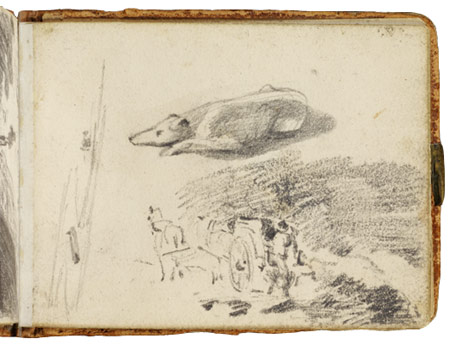 |
| Sketch of a Hay Wain and a dog by John Constable (1821) |
Recently, an artist of our acquaintance criticized a friend of mine's ability to draw. This made me remember (a la Proust) a lecture given by Rose about the English landscape artist, John Constable. Rose projected the painting, The Hay Wain, which is a full-size landscape. In 2005 this painting was voted the second greatest English painting, after Turner's, The Fighting Temeraire. So it is definitely one of the icons of art that Rose loved to deflate.
Next, Rose projected a sketch of a hay wain Constable had drawn as a study for the famous painting. He pointed out in what ways the sketch was not very well drawn. Also in that sketch is a dog that is so poorly drawn as to be barely recognizable as a dog. It looks like one of James Thurber's animals. Rose concluded his lecture by saying that anyone in the lecture hall could draw a sketch as well as that one by Constable. And he urged everyone not to be discouraged in their artistic endeavors.
To date, more than 2700 people have viewed this post. Please comment on this post to add your thoughts, positive or negative, about Jasper Rose.
Subscribe to:
Posts (Atom)